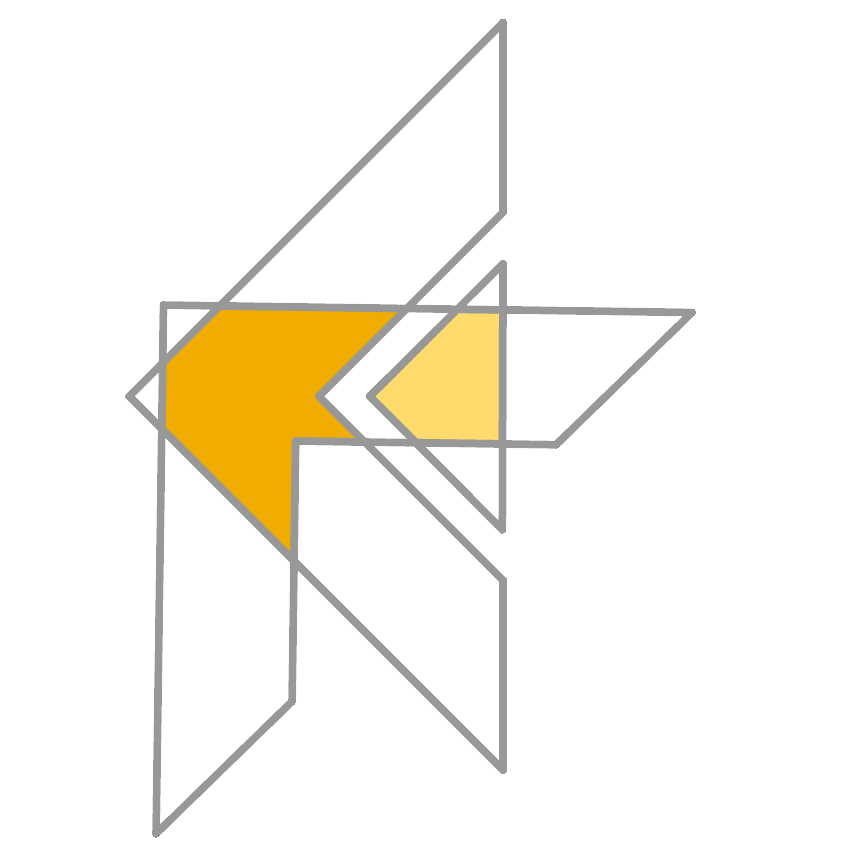
 Euclid.Kontur
FillRule Type
On Euclid.Kontur. Determines how the winding number of a point decides whether the point is inside a Kontur./// The winding number counts how often the paths of a Kontur wind around a point, counter clockwise turns count +1, clockwise turns count -1. The fill rule belongs to the Kontur, not to the boolean operation, unlike in Clipper. Subject and clip get separate winding numbers on every edge, and each fill rule is applied to its own winding number before the boolean combines them. So two different fill rules never conflict, they are two independent decisions. What this buys is one pass instead of two: an EvenOdd glyph unioned with a NonZero CAD outline works in one operation. With a fill rule per operation the glyph would have to be simplified first, then unioned.
Record fields
| Record Field |
Description
|
A point is inside if the winding number is odd. The orientation of the paths does not matter. This is the rule of fonts and of SVG's 'evenodd'. A path inside a path is a hole, a path inside that is filled again.
|
|
A point is inside if the winding number is negative. Needs consistently oriented paths: clockwise outer boundaries, counter clockwise holes.
|
|
A point is inside if the winding number is not zero. Overlapping paths of the same orientation merge. This is the rule of SVG's 'nonzero' and the default of most CAD software.
|
|
A point is inside if the winding number is positive. Needs consistently oriented paths: counter clockwise outer boundaries, clockwise holes. Kontur values returned by a boolean operation always use this rule.
|